|
Types of varicose veins
Telangiectasia
Telangiectasia
on the legs occur in 29% to 41% of woman and 6% to 15% of men . These
smaller vessels are most often directly or indirectly connected to
larger reticular or varicose feeding veins. 53% of these patients have
associated symptoms, if not treated early will inevitably lead to
progressive worsening or superficial venous valvular insufficiency and
eventually leading to deep venous valvular insufficiency. Varicose
veins most likely lead to the development of telangiectasia either
through associated venous hypertension with resulting angiogenesis or
vascular dilation and/or through an associated increased
distensibility of the telangiectatic vein wall. Although
telangiectasia associated with varicose veins may appear at first as
erythematic streaks, over time they turn blue. Often they are directly
associated with underlying varicose veins so that the distinction
between telangiectasia and varicose veins become blurred. Multiple
studies using Doppler and duplex ultrasound examinations have
demonstrated that telangiectasia is associated with underlying
reticular veins. Leg telangiectasia may be associated with underlying
venous disease even when no obvious reticular or varicose veins are
present. Duplex imaging or venous Doppler study revealed the 23% of
patients without clinically apparent varicose veins demonstrated
incompetence of the superficial venous system. The abnormal legs,
however, show a very high incidence, (>74%) of incompetence of
superficial venous system, mainly sapheno-femoral incompetence. These
statistics demonstrate the need for a clinical or non-invasive
diagnostic work up in patient with telangiectatic leg veins and
reinforces the view that "spider leg veins" arise from underlying
varicose veins via venous hypertension, thus leading to the release or
activation of vasoactive substance with resultant capillary or venular
neogenesis (angiogenesis).
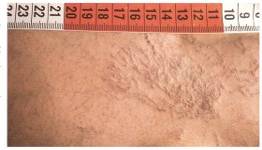
Spider veins
Spider
veins are those unsightly, superficial veins that are blue, purple, or
red in color. There is a safe and virtually painless treatment for
them, called sclerotherapy which does not involve surgery.
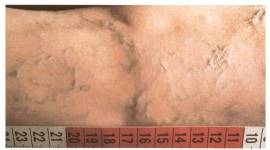
Varicose veins
Varicose veins are those bulging, more
profound veins that are often accompanied by pain, itching, fatigue,
heaviness, and swelling They are caused by a disease called venous
incompetence, in which the vein valves have lost their ability to
function properly, thus impeding the proper circulation of blood back
into the bloodstream. the physician uses an effective, fast and safe
procedure called ambulatory phlebectomy to eliminate the problem at
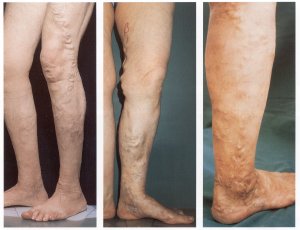
its source. When a varicose disease has been mistreated or left
untreated for a long times complications occur. Complications cause
skin pigmentation, heavy swelling, itching, ulcers, and pain.
Cafer Abbasoğlu
jan 2007
|