|
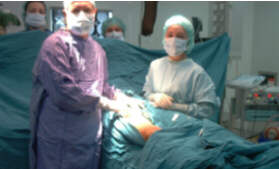
Management
The best treatment
for vein disease is early detection. While there is no known cure for
vein disease, there are options ranging from self-help to surgery.
Medical Compression Stockings
Compression
stockings are often the first line of defense in treating varicose
veins or in slowing their progression. The stockings support the
weakened vein walls and help them perform the pumping action. As a
result, blood flow is increased and often there is a decrease in
swelling, fatigue, and pain and a reduction in the risk of blood clot
formation.
Compression
stockings should only be worn after consultation with a physician. The
physician will indicate the desired compression ratio based on
specific parameters.
Sclerotherapy
is an outpatient
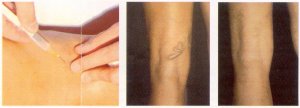
procedure that involves injecting small and medium-sized varicose
veins with a solution that scars the affected veins. The
solution causes the injected vein to close up or
sclerose. Typically these closed veins will gradually be reabsorbed
by the body and disappear. Sclerotherapy relieves symptoms due to
varicose and spider veins in most patients. The procedure is
performed in the office, in sessions that last approximately 15-20
minutes. The number of sessions required will depend on the extent of
veins present. Slight bruising and some pigmentation may occur, but
usually resolve within a few weeks.The scarring effectively closes the
veins and forces the blood to reroute to healthier veins.
Sclerotherapy can be performed as 1- Conventional surface
sclerotherapy in small varicose veins and leg spiders 2- Ultrasound
guided sclerotherapy in large varicose veins and wide spread spiders
EndoLaser Venous Therapy
Is the most recent technology for the treatment of
varicose veins. EndoLaser Venous Therapy or ELVT, is a minimally
invasive laser closure of the greater saphenous vein. Valve failure
in this large vein ascending from the knee to the upper inner thigh is
largely responsible for the formation of the bulging varicosities
frequently seen in the lower leg.The procedure is done in the
office under local anesthesia. A special laser-tipped fiber is passed
through a small catheter inserted into the greater saphenous vein. As
the laser is activated, the resulting heat at the tip causes a
reaction in the walls of the vein causing them to stick together. The
varicosities associated with this vein then disappear as blood from
the lower leg reroutes through the deeper circulation.
The newest technique for varicose vein treatment is endovenous laser,
FDA approved in January of 2002.
In this procedure, a small laser fiber is
inserted into the abnormal vein and the inside of the vein wall is
heated with laser energy
Laser Treatment
In this
technique Laser is used to treat the smaller veins called
telangiectasias that occur in the face and legs.
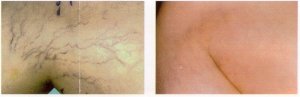
Before Laser Therapy ..........
After Laser Therapy
Surgery
In more severe
cases of varicose veins diseases , surgery may be recommended. There
are various surgical treatment options available.
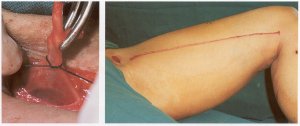
Ambulatory phlebectomy
is an outpatient procedure involving the removal of smaller
varicose veins through a series of tiny skin punctures. The procedure
is frequently preformed under a local anesthetic and scarring is
generally minimal.
Vein stripping
entails removal of
a long vein through small incisions. For most people, this is also an
outpatient procedure and normal activities can usually be resumed
within 2 weeks of the procedure.
Endoscopic vein surgery
is usually considered only in advanced cases of vein
disease involving leg ulcers. Surgeons use a thin video camera
inserted in the leg to visualize and treat the affected veins.
Cafer Abbasoğlu
jan 2007
|